
How to Get Your Business on TV: Inside Tips from a News Executive Producer
Most small business owners assume TV news is out of reach. Too big, too fast, too competitive. They picture a chaotic newsroom and assume their story would never cut through.
Claire Pitman has spent years as a television news executive producer. She is the person who decides what makes it to air. And her message to small business owners is clear: there is more opportunity than you think — you just need to understand how a newsroom actually works before you pick up the phone.
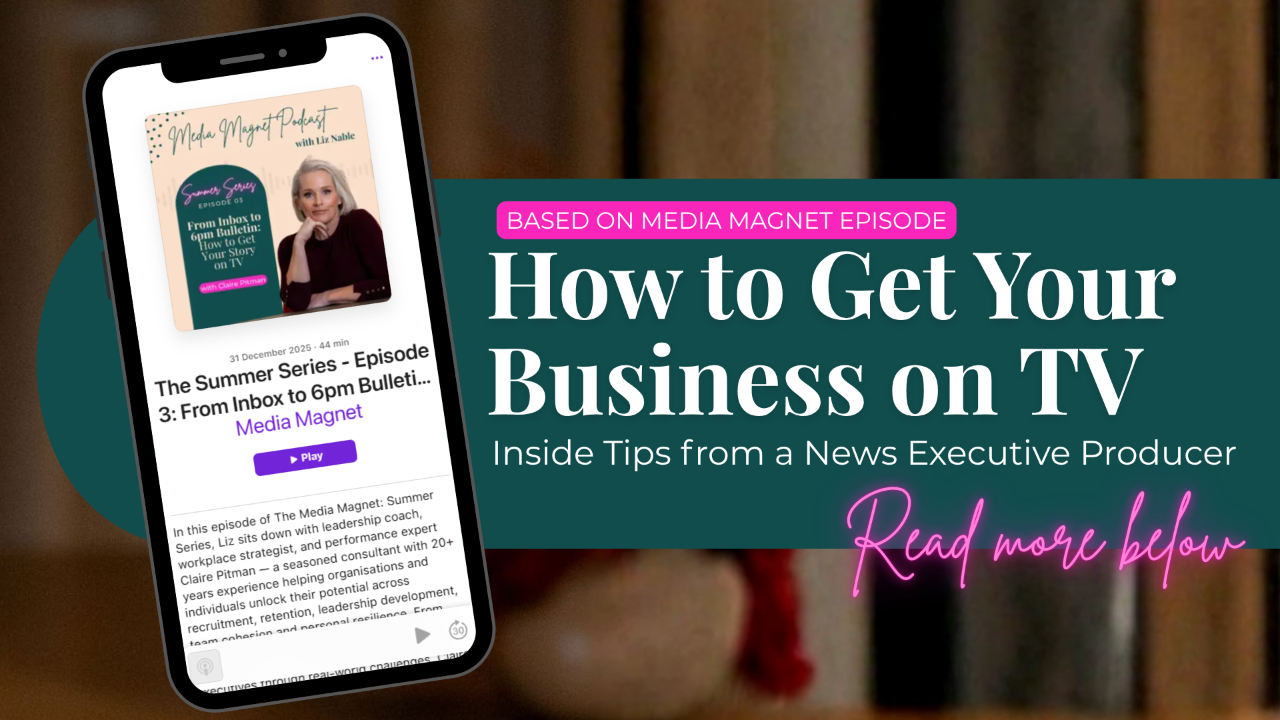
In Episode 3 of the Media Magnet Podcast, Liz Nable sits down with Claire for one of the most practical breakdowns of TV news pitching available to Australian business owners. If you have ever wondered how to get your business on TV, this is the episode that gives you the roadmap.
The Number One Thing TV News Needs From You: Pictures
Television is a visual medium. This shapes everything about what gets covered, how stories are told, and what a journalist needs from you before they can say yes.
Claire puts it simply: pictures, pictures, pictures, every day of the week.
Unlike a newspaper that can lead with a political story or a written analysis, a TV news bulletin needs something that will make a viewer cooking dinner at six o'clock look up from the stove. That means compelling visuals — and if your story does not have them, you need to create them.
That does not mean your business needs to be visually spectacular by nature. It means you need to think about what a camera crew could actually film. A spokesperson speaking to the product or service. A case study in action. A filming location that brings the story to life. The more clearly you can articulate the visual opportunity, the better your chances of getting a yes.
For businesses where there is no obvious visual, Claire points to what newsrooms call graphic sequences — a reporter standing in front of graphics explaining a concept — and to the power of human stories. A third-generation farmer. A staff member who immigrated and retrained. A founder who built something from nothing. People are pictures too.
How a TV Newsroom Actually Works
Before you pitch, you need to understand the structure of the place you are pitching into.
At the centre of a TV newsroom is a round hub desk with multiple desks flowing off it. Phones ringing constantly. Journalists and producers moving fast. At the heart of it is the chief of staff desk — the traffic controller of the whole operation. The chief of staff takes incoming calls, manages camera crew deployment, and assigns journalists to stories. They are busy, they are time-poor, and they need you to get to the point immediately.
But the chief of staff is not the only entry point. Claire flagged a department that is often more accessible and more appropriate for small business stories: the features, promos, and investigations team.
While the chief of staff desk is focused on what is happening today, the features and promos team works on stories that can be pre-organised, shot in advance, and promoted in the bulletin teaser the night before. These are the stories you see promoted during primetime — "coming up tomorrow night on the news..." That journalist has time to invest in your story, to understand it, and to find the angle that makes it work.
If you are not pitching something that needs to happen today, the features desk is where you should be directing your energy.
Same-Day Stories vs. Feature Stories: Knowing Which You Have
Same-day hard news moves fast. If you are pitching into the daily news cycle, you need to be ready to go immediately. The chief of staff is deciding right now what gets covered today. Your pitch needs to be relevant to the news of the day, and you need to have your filming opportunity, your case study, and your spokesperson lined up and available.
Claire gave a direct example: if the federal budget has just announced a significant funding boost to GPs and you can offer a GP from Western Sydney who is affected by that decision and willing to speak on camera — call the chief of staff. You are adding to a story that is already happening. That is exactly the right approach.
Feature and weekend stories operate differently. These are the softer stories, the human interest pieces, the breakthroughs and innovations. They can be pitched days or even a week in advance. They are what fills the back half of a news bulletin — what newsrooms call the pull-through, the content that keeps viewers watching through the ad breaks. These stories need a takeaway: what will viewers learn? How will this better their lives? That is where business stories often live, and there is significant opportunity there.
Claire also flagged weekends specifically as an underutilised window. With fewer reporters rostered on and less breaking news competing for space, a well-pitched feature story has a much stronger chance of getting up on a Saturday or Sunday than it would mid-week.
The News Hook: What It Is and Why You Need One
A news hook is the reason your story is relevant right now. It is the external event, trend, data point, or moment in the news cycle that makes your business story timely rather than just interesting.
Claire's most memorable example from this episode was a tick exterminator from Sydney's northern beaches. La Nina had brought unprecedented rain, and with it, an explosion of ticks and mosquitoes across the city. The exterminator was not the story — the bug invasion was. But the exterminator was the human face, the visual, and the expert voice that made the story work. He got a minute-thirty package on prime time news, reaching an estimated 300,000 viewers in Sydney that night alone.
He could have pitched that himself. He did not — Claire approached him — but he could have. And that is the point.
When cost of living is the dominant news cycle, any business that helps people spend less, earn more, or stretch their budget further has a natural news hook. When energy prices rise, anyone in the renewable energy or home efficiency space has a hook. When a new piece of legislation passes, any expert in that area has a hook.
The formula is: find what the news is already talking about, and identify how your business connects to that conversation.
Your Business Is Not the Story. The Story Is the Story.
This is the mindset shift that changes everything about how you approach TV news pitching.
Journalists are not there to promote your product or service. They are there to tell a story that their viewers care about. Your business might be part of that story — and getting a minute-thirty on the six o'clock news is worth more than almost any advertising spend you could make — but it has to earn its place through genuine news value.
Claire put it directly: a pitch that says "would you like to do a story about my product?" almost never works. A pitch that says "I've noticed this is happening in the news, I have data to support it, and I have a case study who has lived this experience and is available to film today" — that is a pitch that gets a response.
Being part of a bigger story is also significantly better than not getting coverage at all. Claire gave the example of a brand with an Australian-made, affordable, charity-linked Christmas product — rather than pitching a story about the product itself, the smart approach is to offer to be part of the broader cost-of-living Christmas coverage the newsroom is already planning to run.
How to Build a Relationship With Journalists and Get on Their Expert Lists
One of the most valuable outcomes of any media appearance is not the coverage itself — it is getting onto a journalist's list of go-to experts.
Inside every newsroom there is a contact database of people who can be called on when a relevant story breaks. Claire was honest about the reality: these lists are surprisingly ad hoc, often outdated, and not systematically maintained. But individual journalists and producers absolutely keep their own mental rolodex of people who were easy to work with, gave sharp soundbites, and showed up when they said they would.
Getting on that list starts with your first placement — but you can also pitch yourself as an expert even before a story exists. If you know a particular topic is about to become newsworthy, reach out to the journalist who covers that beat and let them know you are available. Not a pitch for your business — a pitch for your expertise.
When the story breaks, they will call you.
What Makes a Great Media Talent: Soundbites That Cut Through
Once you get the call, your job is to be genuinely useful on camera. That means speaking in short, sharp, clear soundbites — the kind that a producer can lift straight into a package.
Claire's tick exterminator nailed it. His line: "These are plague-like conditions and we're going to have an explosion of ticks this summer." That one sentence ended up in the promo that ran on The Block the night before, and again in the package itself. If he had said "it's a little bit worse than last year," it would never have made it to air.
Being enthusiastic, clear, and willing to use plain language about your area of expertise is what gets you used — and what gets you called again. Technical experts who cannot simplify their message rarely make it past the first story. The ones who speak in human terms, stay on message, and show up prepared become the names that journalists save in their phones.
The Five Things You Need in Your TV News Pitch
Claire wrapped up the episode with a practical checklist for anyone ready to pitch a TV newsroom. Here is what you need to have prepared before you make the call or send the email:
1. A clear, concise pitch — Why is this newsworthy? What is the news hook? One or two sentences maximum.
2. The filming opportunity — Where can a camera crew come? What will they film? Give specific locations, what is available, and how quickly you can make it happen.
3. A case study — A real person who has experienced the story you are pitching. Two kids, Western Sydney family, used your product or service, happy to be filmed. This is what transforms a product pitch into a news story.
4. A spokesperson — Someone with credibility on the topic who can speak clearly and concisely. Ideally that is you, but it can also be an expert, a customer, or a relevant authority figure.
5. Availability — If you pitch it, you need to be ready to shoot it. Do not pitch something and then tell a journalist you are not available until next week. TV news moves fast. If you are not available, someone else will be.
Then: follow up. Politely. Persistently. Once you have sent the pitch, follow it with a phone call. Do not ring at 5am or at 5:30pm when the bulletin is about to go to air. Aim for around 9am when the day is being bedded in, or contact them the day before for same-day pitches.
When to Call the Chief of Staff vs. When to Find the Features Desk
To summarise the routing decision:
If your story is happening today and connects to the news cycle of the day — call the chief of staff desk. Have your pitch ready before you dial. Ask to be put through to the journalist or producer assigned to that story.
If your story is a feature, a human interest piece, a weekend story, or something that needs time to set up — ring the chief of staff desk and ask if there is anyone working on features, promos, or investigations. Get their direct contact and pitch to them instead.
And before you pitch anything to anyone — watch the show. Claire said it plainly: there is no point ringing and pitching if you do not know what they cover, what their stories look like, or where your story would sit in the bulletin. Watch the program, understand the format, and then pitch with that knowledge in your opening line.
The Opportunity Is Bigger Than You Think
Claire closed the episode with something worth repeating: individual brands are not pitching TV news anywhere near as much as they should be. The opportunity is real, the demand for genuine small business stories is real, and the newsroom is actively looking for the case studies, experts, and human faces that bring those stories to life.
The businesses that do it well are not the big ones with PR agencies. They are the ones who watch the news, understand the cycle, build the relationship, and show up prepared.
That could be you.
Want to Learn How to Pitch Media With Confidence?
Understanding how TV newsrooms work is the first step. Knowing how to craft the pitch, tell your story, and build the relationships that get you covered consistently is what comes next.
That is exactly what the Media Members Inner Circle is built for — a monthly membership community with the training, tools, and support to help you go from best-kept secret to the name journalists call.
